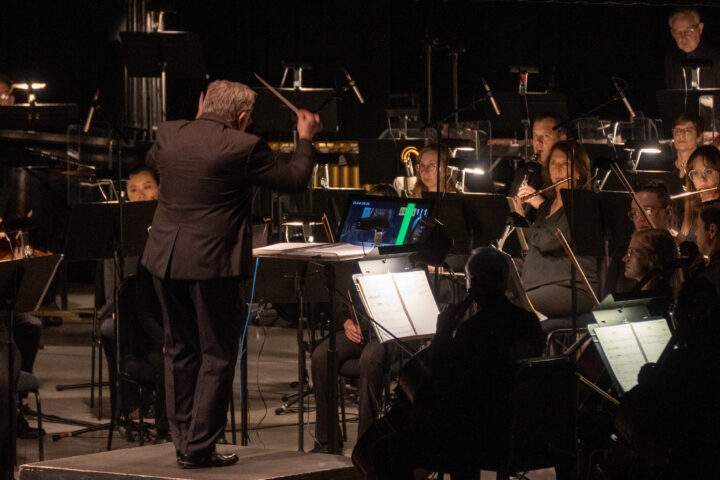
Every composer who has ever scored to picture knows the two shapes: a line that sweeps across the screen, and a flash on the downbeat. Streamers and punches. They're so embedded in film music that it's easy to forget someone had to invent them — and that they were, quite literally, cut into film by hand for decades. This is the story of where they came from, who made them, and why they're still on scoring stages and concert stages today.
Before streamers: a conductor and a stopwatch
In the earliest years of sound film, keeping an orchestra locked to picture was a surprisingly manual affair. Up until the 1930s, the standard approach was a sweep-hand clock with stopwatch functionality placed within the conductor's sightline, paired with a score marked up with the exact second each important moment should land. The conductor essentially raced a clock, glancing between the podium and the second hand to hit the action on time. It worked, but it left little room for musical expression.
Alfred Newman and the Newman System
The breakthrough came from Alfred Newman, one of the towering figures of Hollywood film music and long-time music director at 20th Century Fox. Working at Fox around the 1940s, Newman developed what became known as the Newman System: a way of synchronizing a live orchestra to film using visual marks made directly on a reference print. It's the same arrangement of streamers, flutters and punches that composers still use today.
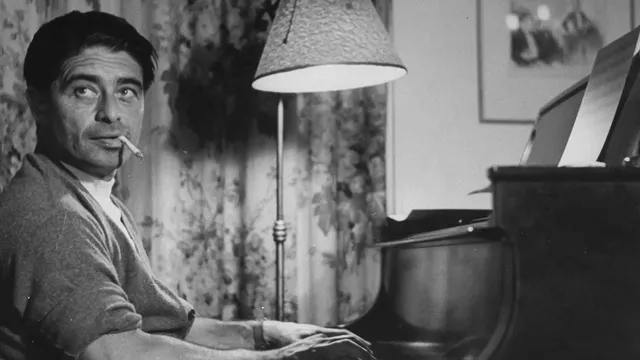
Here's how it worked on physical film:
- Punches were tiny holes made in the film — two out of every ten frames — that, when projected, produced a steady visual pulse. That pulse gave the conductor a reliable beat to lock the tempo to.
- Streamers were diagonal lines scribed across a stretch of the 35mm work print. On screen, the scribe appeared as a line traveling steadily from one side to the other, warning the conductor that a sync point was approaching. The moment it reached the far edge — the hit — a punched hole produced a flash.
The genius of the system was what it left free. Unlike a rigid click track locked to every beat, streamers and punches guarantee synchronization on the hit while letting the conductor breathe with the tempo everywhere in between. The orchestra stays human; the sync points stay exact. Newman is also widely credited with pioneering the click track itself — so both of the main tools composers still use to sync music to picture trace back to the same person.
The film changed. The technology changed. The visual language a conductor reads — sweep, then flash — has barely changed at all.
From celluloid to code
For decades, preparing streamers and punches meant a music editor physically scribing and punching a print, cue by cue. As video and computers arrived, that work moved into software. The best-known early digital tool was Auricle, a system that chased timecode and click from the recording setup and generated the streamer-and-punch overlays electronically — no more cutting film by hand. Auricle earned an Academy technical award and defined the digital era of this craft, even though, by today's standards, it's a relic of the DOS age.
The important point is that digitizing the process never changed the underlying idea. Whether scribed on celluloid or drawn by a GPU, a streamer is still a line that sweeps to a hit, and a punch is still the flash that marks it.
Streamers step onto the concert stage
For most of their history, streamers and punches lived in the studio — on scoring stages and in ADR and Foley rooms, where they're still standard for lining up replaced dialogue and sound effects. Then something changed the audience for them entirely: the rise of film-with-live-orchestra concerts, where a beloved movie is projected while an orchestra performs its score in real time.
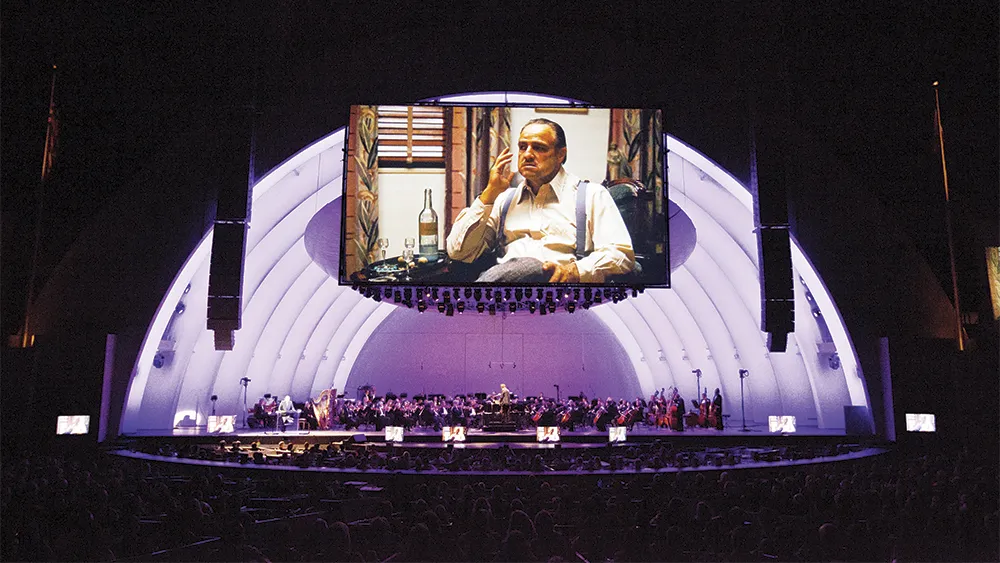
A landmark early example came in 2002. To mark the 20th anniversary of E.T. the Extra-Terrestrial, John Williams took the podium at the Shrine Auditorium in Los Angeles on March 16 and conducted a full orchestra performing the entire score live to the film. It's widely regarded as one of the events that helped launch the modern live-to-picture format — the same format that now fills concert halls worldwide with screenings of Raiders of the Lost Ark, Back to the Future, West Side Story and dozens more.
There's a neat thread running through this. John Williams came up in the Hollywood that Alfred Newman helped build; Newman even mentored a young Williams. And to conduct a film in perfect sync in front of a live audience, a conductor still relies on Newman's invention. Newman's own son, David Newman, has become one of the leading conductors of these live shows — using the very system his father created, now on screens instead of scribed film.
A short timeline
- Pre-1930sConductors sync to picture using a sweep-hand clock and a second-by-second marked score.
- 1940sAlfred Newman develops the Newman System at 20th Century Fox: streamers, flutters and punches scribed onto film.
- Later 20th c.Digital tools such as Auricle move streamers and punches off celluloid and into software.
- 2002John Williams conducts the complete E.T. score live to the film — a landmark for the film-with-live-orchestra concert.
- TodayLive-to-picture concerts are a global phenomenon, and streamers and punches remain standard on scoring stages, in ADR and in Foley.
Why streamers and punches still matter today
It would be easy to assume that in an age of frame-accurate DAWs and in-ear click tracks, a technique invented for scribed film would be obsolete. The opposite is true. Streamers and punches are still the clearest, most musical way to guide a live conductor, precisely because they don't force a rigid tempo. On the modern scoring stage, in the ADR suite, and increasingly on the concert stage, the same sweep-and-flash language Alfred Newman devised is doing exactly the job it was designed for.
What has changed is the tooling. The method deserves software that runs on a current machine — which is exactly the gap tools like CueSync exist to fill: the Newman System's visual language, generated natively on a modern Mac, ready for a session or a stage.